
Strategic Procurement
Intake Management is the Key to AI-Ready Procurement
Intake is the front door to procurement — and the reason most AI programmes stall behind it. The governance, process, metrics and use cases that make procurement genuinely AI ready.

Key takeaways
- Intake is procurement's front door and its data foundation. Every sourcing decision, compliance check and analytics model downstream inherits whatever quality the request arrived with.
- The returns are measured, not theoretical: organisations digitising intake report up to 40% efficiency gains and 50% fewer compliance violations, against up to 30% of buyer time currently lost to data cleanup.
- AI readiness is an intake problem before it is a model problem. By 2027 an estimated 70% of procurement intake will be AI-led, cutting manual triage by over 60% — but only where requests arrive structured enough for an agent to act on.
In Gartner’s 2025 CPO Leadership Vision, 74% of procurement leaders admitted their data isn’t AI-ready. This insight has a deeper implication than many realize:
Your sourcing, analytics, and AI investments are only as good as your intake process.
If the initial request is vague, misrouted, or incomplete, no amount of sourcing tech, negotiation tools, or dashboards can fix what’s already broken.
This is the core of the problem: broken intake breaks procurement.
If your intake is fragmented or flawed, every downstream process absorbs cost and efficiency.
What is Intake Management?
Intake management is how procurement captures, structures, and triages purchase requests from the business.
It’s the first step in the sourcing lifecycle where demand meets process. Whether it’s a request for IT hardware, marketing services, or a new vendor, intake determines how clearly that need is captured, how fast it moves, and how cleanly it feeds into sourcing and approvals.
When done right, it brings structure, speed, and visibility.
Yet, most organizations rely on a fragmented, manual intake process which is managed through a mix of emails, spreadsheets, and static forms. The result? Poor data quality, process delays, and limited visibility into enterprise demand.
To understand the cost of broken intake, let’s take a look at why intake management is critical
The Critical Role of Intake Management
The enthusiasm for applying AI in procurement and sourcing is justified, but it often overlooks a crucial factor: the intake process. Intake is not merely an administrative hurdle, it's the foundation for effective downstream sourcing activities.
Here are Three Core Reasons Why Intake Matters
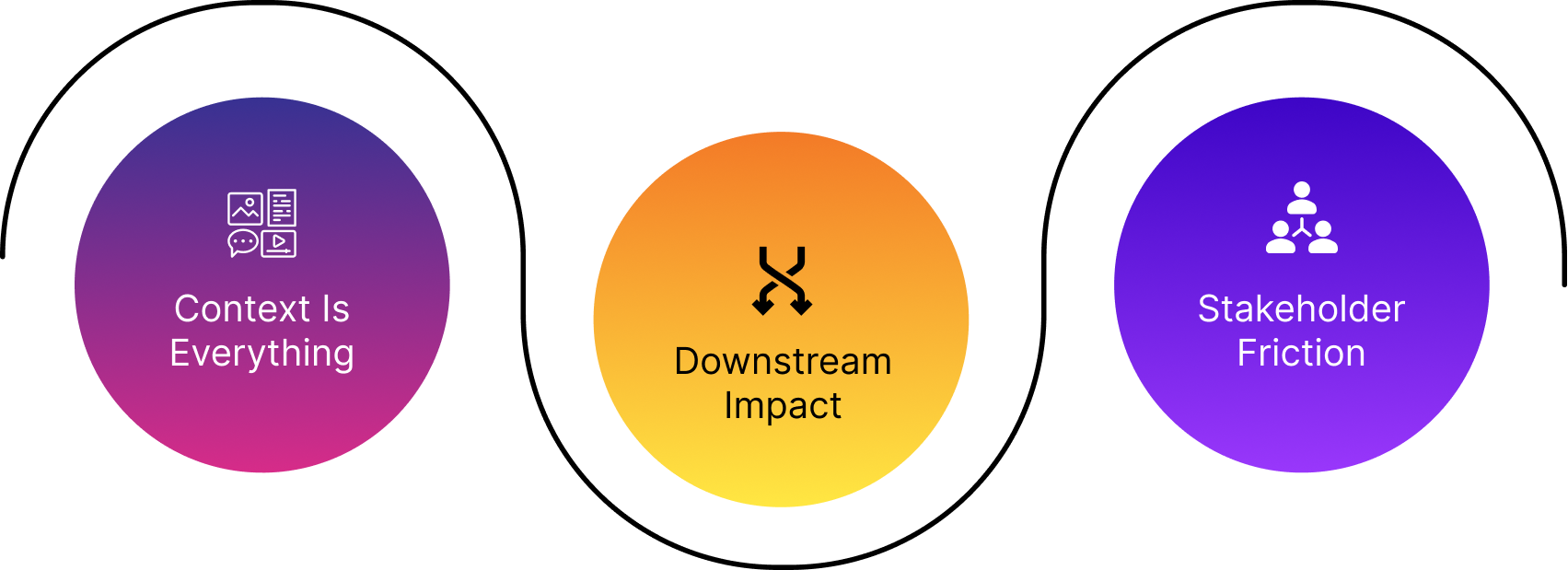
1. Context Is Everything: Intake is traditionally managed through forms, emails, or spreadsheets. Unfortunately, these channels often fail to capture the nuanced needs and context behind a sourcing request. The absence of clear context can result in misunderstandings and poor alignment between stakeholders and procurement teams.
Let’s understand with an example: A business unit submits a sourcing request using a simple form saying:
“Need to purchase 100 laptops for new hires.”
Without additional context, the procurement team might interpret this as a standard laptop purchase and start sourcing generic models focusing just on price.
What’s missing?
- Purpose: Are these laptops for general office use or for specialized tasks like software development or graphic design?
- Specifications: Are there any preferred brands, configurations, or security requirements?
- Timeline: When are they needed? Is it an urgent requirement or a planned procurement?
- Budget constraints: Is there a defined budget or price sensitivity?
- Stakeholder expectations: Are there specific user preferences or support requirements?
Without this context, procurement may select laptops that don't align with user needs, resulting in delays, dissatisfaction, or additional costs.
2. Downstream Impact: When intake requests come through basic forms or emails without guided questions or follow-up clarification, you lose critical context up front. As a result, every subsequent stage like RFX creation, supplier negotiation, competitive evaluation is built on shaky ground.
Here’s how flawed intake impacts downstream procurement processes:
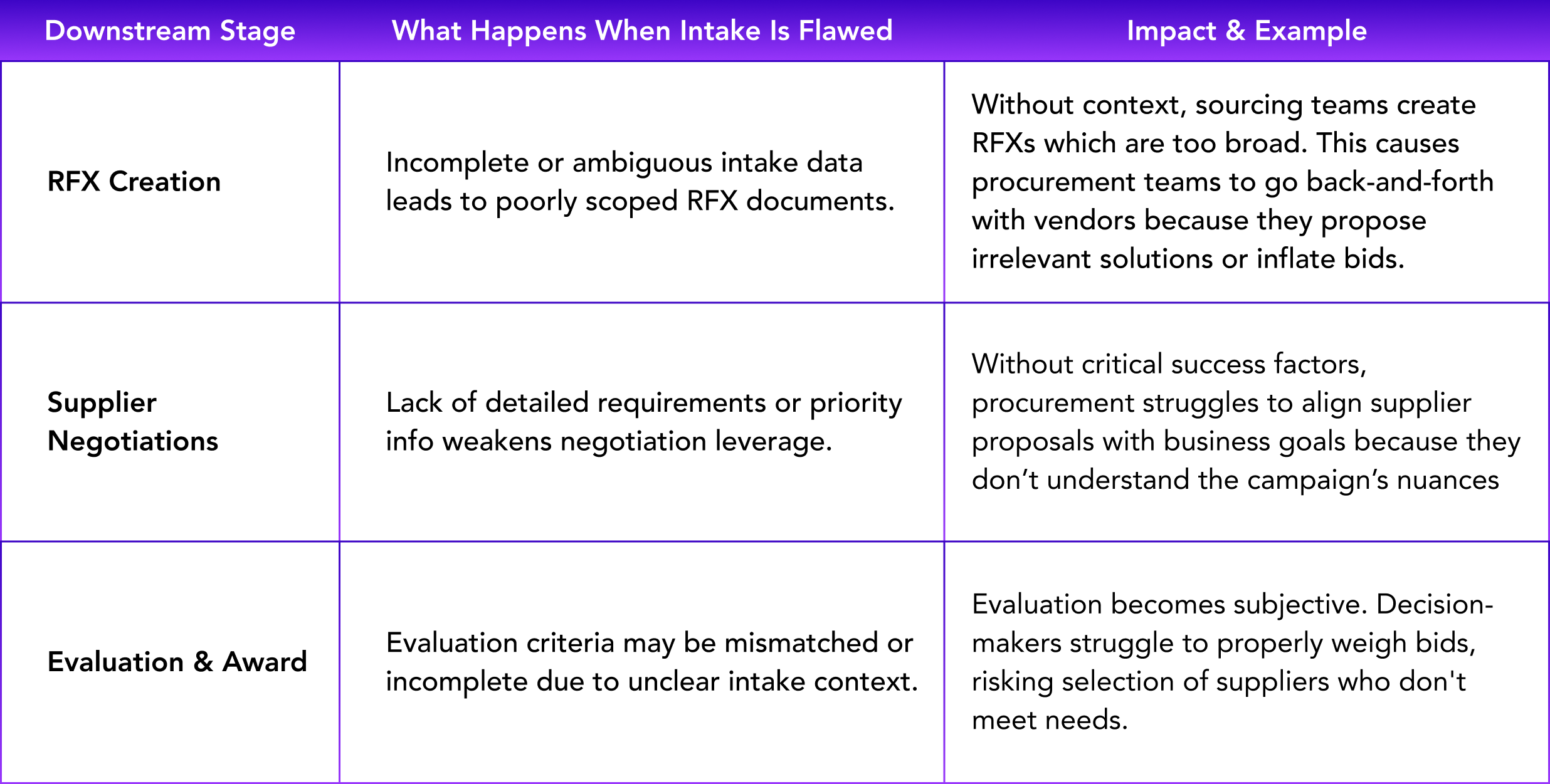
This ripple effect clearly shows that inaccurate or incomplete intake data cascades down the entire sourcing process, undercutting the effectiveness of even sophisticated AI tools designed to optimize sourcing, supplier selection, and risk management.
3. Stakeholder Friction: Nothing erodes trust faster than a stakeholder who feels ignored or misunderstood. If your intake form doesn’t capture “why” and “what success looks like,” stakeholders quickly disengage.
The consequence?

Purchases bypass sourcing, negotiation, and compliance entirely, creating significant risk exposure and lost savings opportunities
Why Managing Intake is the Key to your AI Driven Procurement
Contextual Data Quality Equals AI Performance: AI fundamentally thrives on the quality and the richness of your contextual input data. Why?
AI learns patterns, identifies trends, and makes predictions based on input data. If that data is incomplete, inaccurate, or lacks context, AI models will “learn” from flawed examples, resulting in misleading or suboptimal recommendations.
In procurement, context means understanding:
- Why a purchase is needed
- What specific requirements must be met (specifications, compliance, quality)
- How the product or service will be used
- When it is needed (timing, urgency)
- Constraints such as budget limits or regulatory rules
Without this depth of contextual information, AI cannot differentiate between superficially similar requests, failing to tailor sourcing strategies or supplier matches effectively. Advanced AI tools can help clean, harmonize, and enrich data, but they would still require a solid foundation of high quality, relevant contextual data to begin with.
What Intake Needs Before it Can Power AI
Before jumping into full blown AI implementation, fix the basics. Small process tweaks like structured intake and clearer context capture lay the foundation. Without these, AI only accelerates the mess. Here’s what you can start with:
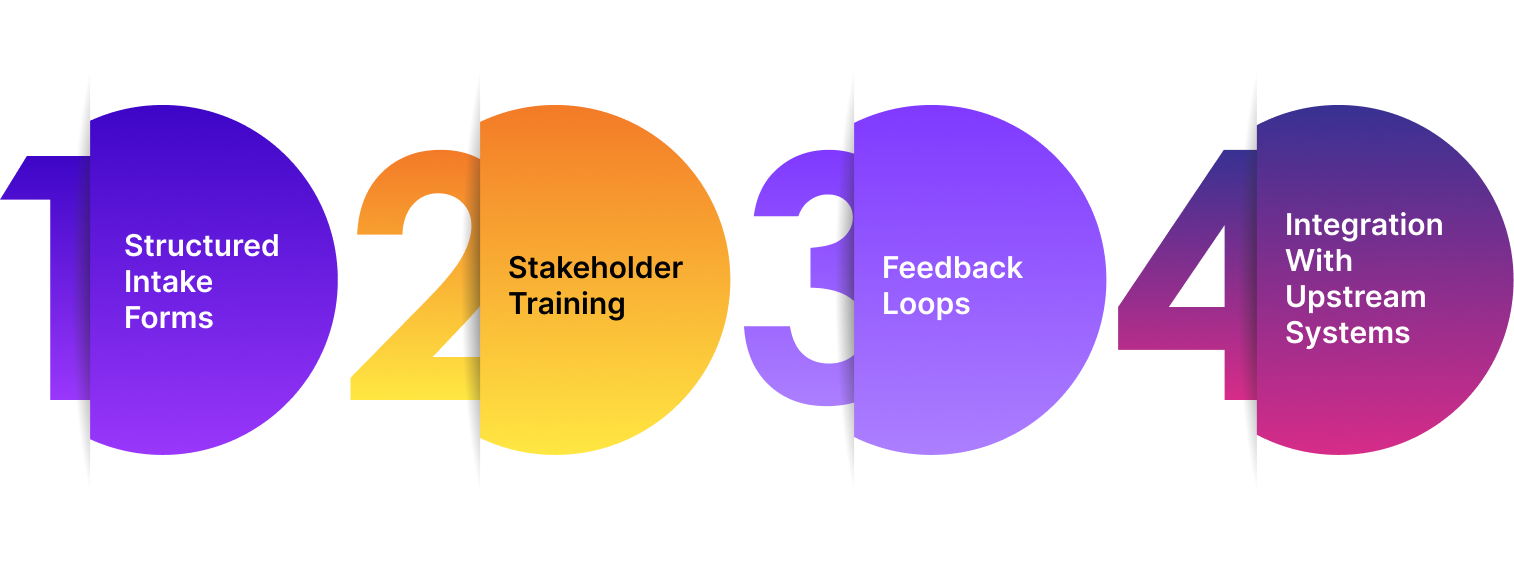
- Structured Intake Forms: Implement digital forms tailored to each category or request type, requiring mandatory context fields, spend rationale, and business objectives.
- Stakeholder Training: Educate business users on why context matters and how better intake benefits their own objectives.
- Feedback Loops: Establish mechanisms to revisit and improve intake questions based on downstream bottlenecks and stakeholder feedback.
- Integration With Upstream Systems: Link intake tools to ERPs, CRMs, or project management systems to automatically pull in background context.
The New Playbook: From Forms to AI Intake Agents
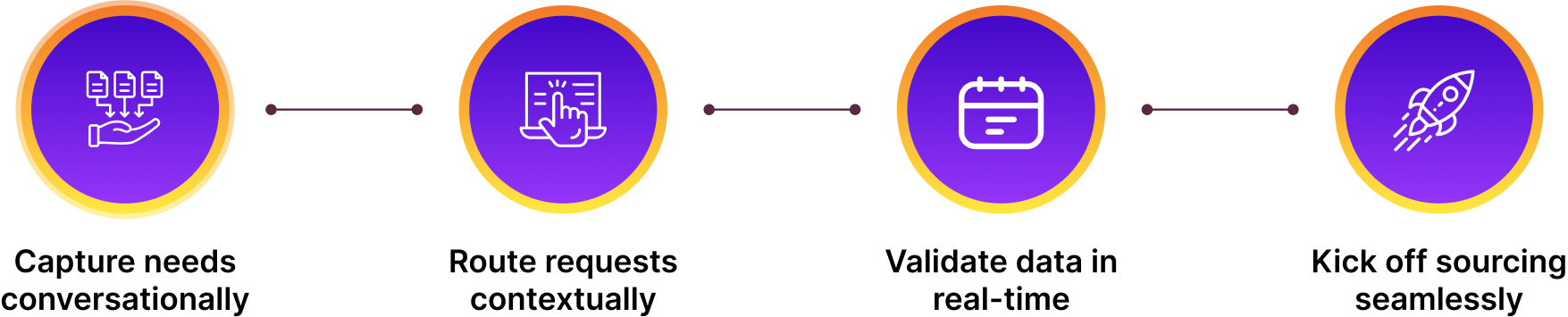
Traditional workflow engines and rigid forms weren’t designed for today’s pace. The breakthrough comes with agentic intake. AI systems that don’t just capture data but orchestrate action:
Agentic intake
Four moves, beyond static forms
conversationally
contextually
in real-time
sourcing
- Capture needs conversationally
Let users describe what they want in natural language. The agent extracts scope, specs, budget, and compliance automatically. - Route requests contextually
Based on category, project, risk level, and budget owner, the agent triages and routes automatically without manual sorting. - Validate data in real-time
No more “missing cost center” errors or vague justifications. The agent checks inputs on the fly and flags issues before submission. - Kick off sourcing seamlessly
Clean, enriched requests flow directly into sourcing workflows without rework and delays
The Bottom Line
Broken intake is slowing you down and blocking your AI strategy, driving up cycle time and opening the door to risk and maverick spend.
This is your front door moment. Fixing intake is a strategic lever for CPOs looking to accelerate speed, improve decision quality, and future-proof procurement operations.
Aerchain’s AI-powered Intake Agent redefines how procurement requests are captured and validated without the back-and-forth.
Here’s how it works:
- Conversational Intake: Stakeholders describe what they need in plain English. No clunky forms, no guesswork.
- Real-Time Validation: AI intake agent auto-checks for missing specs, budgets, cost centers, and compliance gaps before submission.
- Smart Triage: Requests are instantly categorized and routed to the right team based on project type, region, risk, or spend.
- One-Click Orchestration: Sourcing, legal, onboarding, and approvals get triggered directly from intake without manual intervention
Ready to Transform your Intake?
The result? Procurement gets clean, complete, and sourcing ready requests from day one.
Ready to transform your intake management and drive your business forward? Request a demo and discover the power of Aerchain for yourself.
Frequently asked questions
What is intake management in procurement?
It is the governed process of capturing every procurement request through a single structured entry point, validating it at submission, and routing it automatically to the right team. It differs from an intake form in having an owner, rules about what counts as complete, and measurable service levels.
Why is intake management the key to AI ready procurement?
An agent can only reason over the context it is given. When requests arrive unstructured and incomplete, AI produces recommendations nobody can defend, so teams revert to manual overrides. Structured intake is what makes procurement data good enough for automation to act on — which is why it sits on the critical path to every other AI initiative.
What results does digitising intake deliver?
Organisations digitising their intake processes have reported up to 40% efficiency gains and 50% fewer compliance violations. The mechanism is straightforward: less buyer time lost to data cleanup, fewer requests bypassing policy, and fewer PRs needing rework before they can be sourced.
Which intake metrics should we track first?
Percentage of requests submitted with complete data, and percentage of PRs approved without rework. Both move before cycle time does, so they show whether an intake programme is working while there is still time to adjust. Add intake SLA adherence and percentage of spend captured via intake as the programme matures.
How much of intake will AI handle?
By 2027 an estimated 70% of procurement intake is expected to be AI-led, with manual triage down by over 60%. In practice the split is that AI handles capture, validation, routing and standard approvals, while people stay on the bespoke and commercially sensitive requests.

.png)
Ready to Source Autonomously with Aerchain?
Explore the power of AI Agents in transforming procurement processes.