
State of AI Procurement in 2026
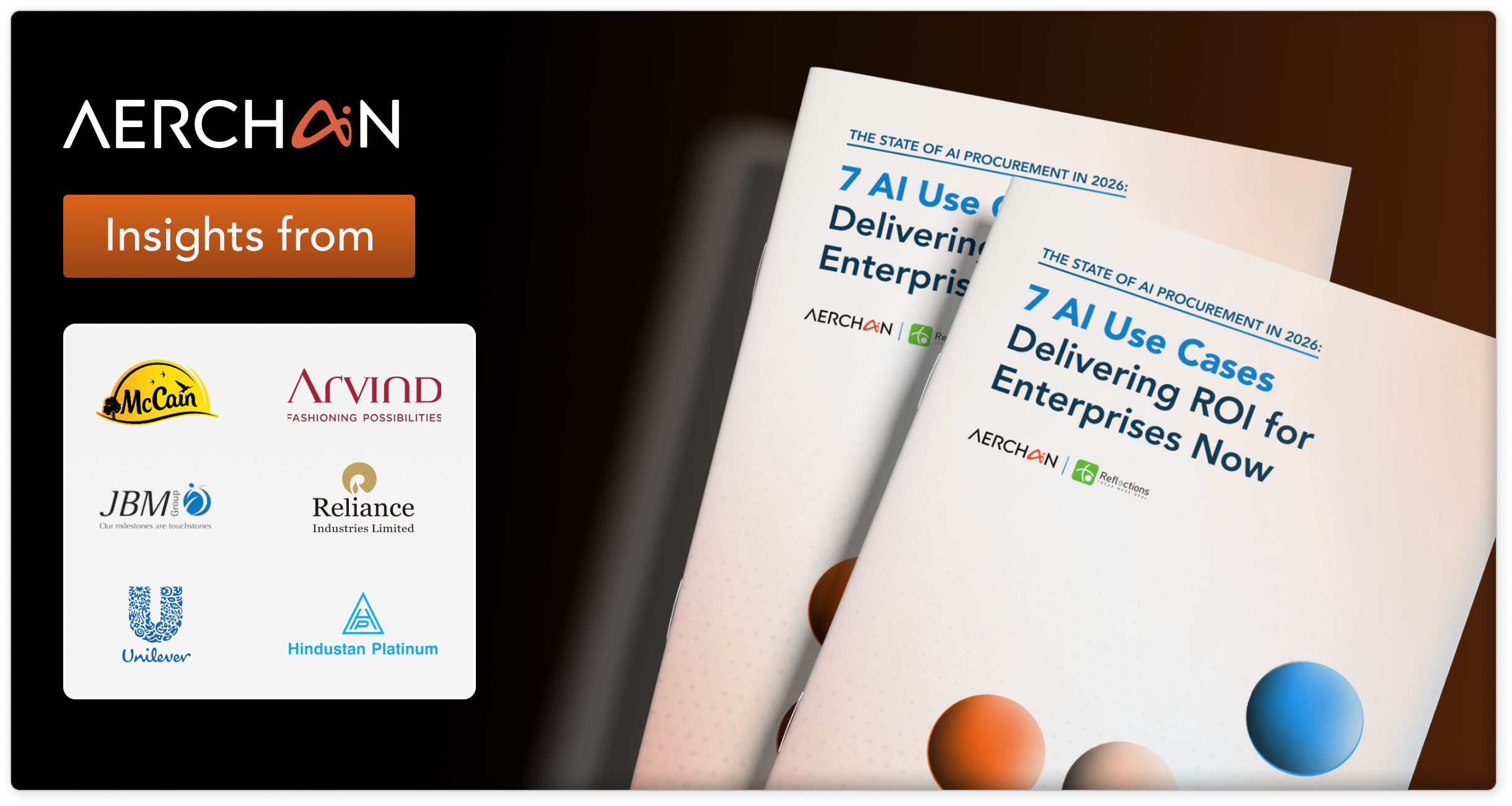
The State of AI Procurement in 2026:
Seven AI use cases that 163 procurement leaders across the US, Asia and the Middle East are actively funding this year — and the time and savings each one is returning.
Key takeaways
- AI in procurement has crossed from pilot to non-negotiable — nearly all 163 leaders interviewed reported using AI in some capacity, with a rapidly growing share running agents.
- Seven use cases surfaced consistently, and the returns are specific: negotiation prep down from 4–5 hours to under 30 minutes, bid evaluation from 3–4 weeks to 3–5 days, supplier onboarding 50–70% faster.
- The strongest results come from applying AI to repeatable work with clear decision criteria and defined exception paths — not to the most bespoke sourcing in the portfolio.
In this 2026 edition of Aerchain’s annual AI research, we reveal how global procurement leaders are using AI today, where adoption is headed, and exactly what you can deploy this year to drive high ROI.
Inside the report
Seven use cases leaders are funding
Frequently asked questions
What is the state of AI adoption in procurement in 2026?
It has moved past experimentation. Of the 163 senior procurement leaders interviewed for this research, nearly all reported using AI in some capacity, with a rapidly growing share running AI agents rather than predictive or generative tools alone. Leaders expect autonomous or near-autonomous operation in these areas within 12–18 months.
Which procurement AI use cases deliver ROI fastest?
The ones built on repeatable work with clear decision criteria. Intake shows the sharpest change — drafting RFx falls from two days to ten minutes — followed by negotiation prep (4–5 hours to under 30 minutes) and bid evaluation (3–4 weeks to 3–5 days).
How is agentic AI different from procurement orchestration platforms?
Orchestration routes information between point solutions, and each added tool increases integration complexity until the layer is as complex as the process it was meant to simplify. Agents instead operate across workflows on shared enterprise context, reasoning and executing without manual prompts, so orchestration becomes native rather than configured.
Where should an enterprise start with procurement AI?
With repeatable, rules-based work that has defined exception paths, keeping human approval gates on bespoke or commercially nuanced sourcing. Autonomy then expands incrementally as data quality and governance mature.

.png)

Ready to Source Autonomously with Aerchain?
Explore the power of AI Agents in transforming procurement processes.